EMT Practice Test

1. Question Content...


Question List

Question1: You work for company who are pioneers in smart energy technology. One of their core products is their home energy monitor that displays current and historic energy consumption data to many thousands of customers in their own homes. It has been designed to integrate with their other smart home products, including domestic lighting control systems via their HomeHub.
The company is planning to launch a new application for smartphones and tablets that will allow customers to view their energy readings remotely and also view their daily budget usage based on seasonal historic data. The application must support customers with disabilities.
The application is being delivered using a hybrid mix of agile and V-model methodologies over three iterations:
Iteration 1 - Development of the new application to work on the IOS operating system only.
Iteration 2 - Enhancement to the application to also work on the Android operating system.
Iteration 3 - Enhancement to the application to provide daily budget usage.
As the test analyst, you have been asked to review the risk register and design test conditions for the highest priority product risks that fall into your area of responsibility, relating to Iterations 1 and 2 only.
Which of the following product risks would you design test conditions for first?

Question2: A diamond retailer is introducing a new stock taking system. Each diamond is assigned a character that represents the colour. The valid domain for the character ranges from D to Z. The colour is then graded using the following scale:

Which of the following test sets will provide the best equivalence partitioning coverage?

Question3: According to the ISTQB Advanced syllabus, which of the following would be the MOST effective method of communication between test team members who are distributed across several time zones?

Question4: What is the MOST important reason why test conditions should be understandable by stakeholders?

Question5: You work for a software testing consultancy firm, SOFTEST, that specialises in the travel industry. It has built up a portfolio of clients across two main travel sectors; the airline and rail sectors. SOFTEST has an established test process, an experienced team of testers and maintains comprehensive organizational defect taxonomies for both sectors.
Two new projects are underway:
Project A is for a new cruise sector client. It will deliver a new user interface allowing its customers to search for cruises using several drop-down fields, each with many values, providing a much greater range of combinations than customers previously had. The project is using a SCRUM methodology with 2 week sprints and well specified user stories.
Project B is an existing airline sector client, who is upgrading the business rules engine that determines how air miles are allocated to its customers. Regression testing must also be performed to ensure the rules engines does not introduce defects in other areas, however, time is limited and there is no existing regression pack. Experienced cruise sector testers have been recruited by SOFTEST to support test effort on this project Which option below describes the BEST test techniques to apply for each project?

Question6: When would the Test Analyst's involvement in an Agile project normally start?

Question7: Ken, an entrepreneur in Leeds finds the quality of the tea locally available so low, that he decides to research superior teas around the world. He decides to market, sell and distribute these superior teas via the web. His market strategy is to offer superior products on a well-designed website with graphics that are fast to load, has high availability, superior usability and fast response times.
The website will offer the following:
- An innovative interactive catalogue of teas, which not only enables customers to buy the product, but also enables them to provide feedback by rating the teas (which will influence his stock purchasing levels)
- Provide the customer with the ability to use secure credit card transactions
- Provide the customer to give general feedback
Ken selects an iterative model for the development of the prototypes. The team consists of three developers that are experienced in web development. Ken, although he doesn't have technical skillset, is concerned with quality. He doesn't believe a lot of documentation is necessary and he wants the website to be completed quickly.
The test basis contains the following:
- Story boards that show the information flow and page links through the site
- HTML pages developed to date.
- A statement of non-functional requirements.
With the strategy taking shape, Ken asks your advice on the specific testing techniques that should be used to complete the required testing, bearing in mind the nature of the application and the nature of Kens overall objectives.
How does phase containment contribute to reducing the cost of development?

Question8: Which of the following is the LEAST appropriate action to mitigate product risks for a web application?

Question9: As part of defining an approach the usability, acceptance criteria need to be defined. Which of the following acceptance criteria would be appropriate for operability?

Question10: Which test technique is MOST closely associated with classification tree diagrams?

Question11: Which TWO of the following are MOST likely to be defects found as part of portability testing?
a. Insufficient, unclear installation or de-installation instructions.
b. Clumsy screen navigation and input screen labelling.
c. Inability to log on as an administrator.
d. Time out errors when entering incorrect login details.
e. The stock control barcodes cannot be read by the replaced barcode scanner.

Question12: Which ISO 9126 quality attribute is most likely to always be of importance when testing a web site?

Question13: Your test team is currently executing interoperability testing. Consider the following excerpt from the failure description of an interoperability defect report:
1. Connect external camera to a Windows Vista PC.
2. Start the camera application on the PC. Application starts normally and recognizes connected camera.
3. Attempt to download the recorded data from the camera.
4. Data does not download.
5. Attempt to download the data three times. Data will not download.
Based on this information alone, which of the problems described hereafter exists in this defect report?

Question14: A software component for a game application calculates a player's trophy level based on the following three input parameter values and their associated rules:
Time to Complete Game - Maximum 180 seconds. If the input value exceeds this amount, then the component outputs error message TIME1 Points Earned - minimum 5 to a maximum of 25. If the input value is outside this range the component outputs error message EM1 Level of Difficulty - from 1 to a maximum of 4. If the input value is outside this range the component outputs error message EM2 Assuming there are no error messages, a total score is then calculated by the component as (Points Earned * Level of Difficulty) The trophy levels are:
Blue - total score equal to or less than 40
Silver - total score > 40
Gold - total score > 70
Diamond - total score > 80
Platinum - total score > 90
The component then outputs the correct trophy level
Applying the Equivalence Partition test design technique to this component and assuming that each error message and each trophy level represents a separate output partition, what percentage of the total output partitions have been exercised by the following suite of test cases?
Player 1 - Points earned 25, level of difficulty 2, time 60 seconds.
Player 2 - Points earned 20, level of difficulty 3, time 120 seconds.
Player 3 - Points earned 30, level of difficulty 1, time 200 seconds.

Question15: Ken, an entrepreneur in Leeds finds the quality of the tea locally available so low, that he decides to research superior teas around the world. He decides to market, sell and distribute these superior teas via the web. His market strategy is to offer superior products on a well-designed website with graphics that are fast to load, has high availability, superior usability and fast response times.
The website will offer the following:
- An innovative interactive catalogue of teas, which not only enables customers to buy the product, but also enables them to provide feedback by rating the teas (which will influence his stock purchasing levels)
- Provide the customer with the ability to use secure credit card transactions
- Provide the customer to give general feedback
Ken selects an iterative model for the development of the prototypes. The team consists of three developers that are experienced in web development. Ken, although he doesn't have technical skillset, is concerned with quality. He doesn't believe a lot of documentation is necessary and he wants the website to be completed quickly.
The test basis contains the following:
- Story boards that show the information flow and page links through the site
- HTML pages developed to date.
- A statement of non-functional requirements.
With the strategy taking shape, Ken asks your advice on the specific testing techniques that should be used to complete the required testing, bearing in mind the nature of the application and the nature of Kens overall objectives.
Which of the following represents the best choice of testing techniques in this scenario?

Question16: Which of the following is an example of testing as part of the requirements specification phase?

Question17: A web-based system is being developed to support the administration of tennis tournaments.
The system provides advice on how much money to offer each player as their individual attendance fee. The amount depends on a COMBINATION of the following factors:
Overall attendance fund (divided into five numeric ranges).
Player's current world ranking (divided into ten numeric ranges (i.e. top 10, top 20, top 30, other).
Whether it is a local tournament for the player (i.e. YES or NO)
Their relationship with the tournament sponsors (i.e. clothing, equipment, or endorsement).
Their previous attendance history at this event (i.e. finalist, played, withdrew before event or withdrew during event) It has been noted that the attendance fee calculation does not take account of 'last minute' invitations that are made to replace a player who withdraws close to the tournament start date. In this case enhanced attendance fees are offered depending on whether the invitation is made within a week, a fortnight, or a month of the tournament start date.
Which of the following specification-based techniques would be the BEST choice for testing that the appropriate fees are calculated for the 'last minute' scenario, and what type of defect is being targeted by the testing?

Question18: You are working as a tester on a project to develop a point-of-sales system for grocery stores.
Which of the following is a product risk that could be identified for such a system?

Question19: Which of the following comments would be the MOST important one you would make?

Question20: Consider the following fault attack:
"Force all possible incoming errors from the software/OS interfaces to
the application".
Which of the following is the kind of failure you are looking for when using this attack?

Question21: You work for an insurance company that is running several parallel projects. You have been asked to advise on the best approach for test case design for each project.
Project A has recently been delivered into production and is planning for its first maintenance release of several minor changes to the user interface. The testers in the maintenance team were involved throughout the development project and will design and manually execute the test cases.
Project B is the development of a new algorithm to improve risk assessment. The testers are experienced in algorithm testing. Test automation is critical as the risk of regression is perceived as high. An audit of the project will be undertaken by an external auditor after the first release into production.
What level of test case design would you recommend for these projects?

Question22: The following depicts a main path through the use case, 'Return Item':
USE CASE: Return Item
Use case ID: UC14
Purpose: Customer selects an item for return and prints return label
Actors: Customer, System
Pre-conditions: Customer has opened shopping site home page

The following Exceptions have been defined:
E1. Customer is already logged-in to account, therefore Main Menu displayed. Occurs at step M2.
E2. Invalid Log-in details entered, prompt for re-try. Occurs at step M4.
E3. Third invalid log-in attempt, account frozen for 24 hours and process ended. Occurs at step M4.
E4. Go-Back requested. Occurs at steps M7 (to go back to 'Main Menu') and M9 (to go back to
'Order History' screen).
You are to apply the Use Case test technique, where the following coverage rules have been defined in the test plan:
One test case should be designed for the basic behaviour.
Multiple alternate behaviours may be incorporated into a single test case provided they are mutually compatible.
Nested alternate behaviours, where there are termination versus non-termination alternate behaviours within a "retry" exception behaviour, should be amalgamated into single test case.
Applying these rules to the Return Item Use Case, how many test cases should be designed?

Question23: While identifying scenario's for the use case "copy A4 - A4" for a new copier, the following scenario's were identified:
Basic scenario: single side to single side
Deviations: single side to double side, copy of a set, copy using the automatic document feeder Failures: no paper in paper tray, paper jam, out of staples How many test cases will be needed to achieve minimum coverage?

Question24: Tax system
A tax system needs to be updated due to new legislation. For a person with a salary of less than
20.000 and who is married, the tax needs to be re-calculated. If the person also has more than two and less than five children, an additional 10% reduction is applicable.
How many cases are required to test the "Tax system" specification using a decision table which is not collapsed?

Question25: The development manager has reviewed the initial inspection results in the company and has discovered that your inspection logging rate is 2 issues per minute and the average checking rate is 5 pages per hour. Around 10 major defects are found per page. The manager is willing to invest more money in your inspection programme. What should he/she do?

Question26: To enhance both the effectiveness and efficiency of the test design phase the purchase of a test design tool is being considered. Which one of the statements hereafter best characterizes a test design tool?

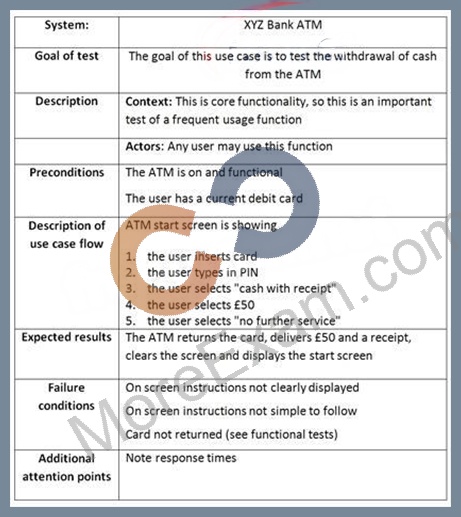
Question27: The use case will be used as a basis for the design of usability test scenarios. As a tester you are asked to review the ATM use case from the perspective of usability testing.
As a tester you are asked to review the ATM use case provided below. The use case will be used as a basis for functionality testing to be performed later.

Which one of the comments, described hereafter, would be the MOST important one you would make?
Question28: Supercar
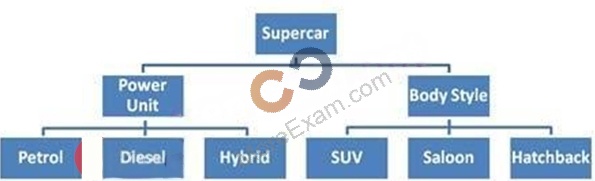
Supercar is an online vehicle sales website specializing in single manufacturers Sports Utility Vehicles (SUVs) and saloons. A vehicle has two key elements, power unit and body style. The manufacturer offers three choices of power unit: petrol, diesel and hybrid. There are 3 main body styles: Saloon, Hatchback and SUV. SUVs only come as petrol and diesel options. Hybrid is available for Hatchback only. The site will allow an order to be processed if the chosen vehicle configurations are in stock, otherwise a message will be displayed asking the user to try again later.
Based on the specification the following classification tree has been developed:

Based on the "Supercar" classification tree the following positive test cases have been created:

Which test case is needed to complete the set?

Question29: Which ONE of the following test tools would MOST likely be used as part of test design?

Question30: In an organization using keyword-driven automation, which of the following activities typically is the responsibility of the test analyst?

Question31: A new web site must operate correctly with different browsers (Internet Explorer, Google Chrome, Firefox, Netscape, Mozilla), using different plug-ins (Realplayer, Mediaplayer), will be receiving pages from different servers (IIS, Apache and WebLogic) and will be running on various server operation systems (windows 2007, XP, Linux).
Which of the following test techniques will you use to test this new web site in its various environments?

Question32: You work for a company who are pioneers in smart energy technology. One of their core products is their energy monitor in-home display device, used to display current and historic energy consumption data to many thousands of customers. It has been designed to integrate with their other smart home products, including domestic lighting control systems via their HomeHub.
The energy monitor in-home display device has been designed to interact with the home's lighting system and automatically dim bedroom lights when the daily energy budget has reached 90%. A defect has been found in the energy monitor's software which causes lights to be dimmed at 80% of the daily budget. What type of testing would MOST likely have uncovered this defect?

Question33: Supercar is an online vehicle sales website specializing in a single manufacturers Sports Utility Vehicles (SUVs) and saloons. A vehicle has two key elements, power unit and body style. The manufacturer offers three choices of power unit: petrol, diesel and hybrid. There are 3 main body styles:
Saloon, Hatchback and SUV. SUVs only come as petrol and diesel options. Hybrid is available for Hatchback only. The site will allow an order to be processed if at least one of the chosen vehicle configuration is in stock, otherwise a message will be displayed asking the user to try again later.
As a tester you are asked to review the "Supercar" specification before starting to design the corresponding test cases.
Which of the comments below would you make?

Question34: You are testing the processing of a critical traffic control system to which various regulations apply. The processing of the input variables is dependent of defined ranges within which the actual retrieved data values can lie.
Which of the following test techniques will you use to the processing functionality of the traffic control system?

Question35: For an ATM banking project introduced earlier, "When the user first inserts a valid credit card type, the system considers the user to be in an unauthenticated state. When requesting a cash advance, the user must be in an authenticated state. The user authenticates by entering the proper PIN code. When authenticating the user, the system shall allow the user to enter their PIN code up to three times before failing the authentication and rejecting the card. On the first and second try, the system shall prompt the user to re-enter the PIN code." Suppose you are concerned that, depending on the exact number of invalid PIN codes entered, the system might behave improperly. Which of the following test design techniques is specifically targeted at such failures?

Question36: Applying the State Transition test technique to the State Transition diagram above, how many invalid transitions are there to test?

Question37: Tax system
A tax system needs to be updated due to new legislation. For a person with a salary of less than
20.000 and who is married, the tax needs to be re-calculated. If the person also has more than two and less than five children, an additional 10% reduction is applicable.
How many input classes can be distinguished when applying equivalence partitioning to the "Tax System" specification?

Question38: You work for an insurance company that is running several parallel projects. You have been asked to advise on the best approach for test case design for each project.
Project C has been experiencing quality issues with the requirements documentation. In previous releases, the requirements were perceived to be vague and inconsistent, prompting many time- consuming questions from the test analysts during analysis and design. For the current release, more formal requirements reviews have been introduced to try and improve quality.
Project D has recognised the need for better regression testing and it is expected that 80% of the test cases created in the next release will form part of the regression pack. The regression tests will be run manually with a plan to introduce automation for future releases.
What should your recommendation be with respect to the level of test case design for projects C and D?

Question39: Which of the following statements about defect based techniques is TRUE?

Question40: You are testing a significant enhancement to the user interface design for a mortgage approval program, used internally by mortgage lenders.
There are many user roles involved in the process of reviewing and approving new mortgage applications. You have completed the testing that ensures the enhancements are functionally correct and you must now ensure that the enhanced user interface meets the needs of all user roles in a way that will be considered acceptable by them.
Which test technique would be MOST suitable for this next stage of testing?

Question41: A web-based system is being developed to support the administration of tennis tournaments.
The system provides advice on how much money to offer each player as their individual attendance fee. The amount depends on a COMBINATION of the following factors:
Overall attendance fund (divided into five numeric ranges).
Player's current world ranking (divided into ten numeric ranges).
Whether it is a local tournament for the player (i.e. YES or NO)
Their relationship with the tournament sponsors (i.e. clothing, equipment, or endorsement).
Their previous attendance history at this event (i.e. finalist, played, withdrew before event or withdrew during event) The new system needs to be ready for the next tournament in just a few months' time, so testing schedules will be severely challenged.
Which specification-based technique would be the BEST choice in the circumstances?

Question42: Which of the following is a typical defect that the classification tree method would identify?

Question43: Which of the following is a TYPICAL defect found in functional completeness testing?
Question44: A new banking system has 2 customers types, 2 account types and will operate in two different countries?
How many test cases will be needed using the pair wise testing technique and the appropriate 2- wise orthogonal array?

Question45: Consider the following description in a defect report "Nasty bug trashed contents of new file that I created by formatting some text in symbol font, wasting my time." Which TWO of the following comments would you immediately make based on the defect description above?

Question46: You are a test analyst in the banking domain. You have received the following requirement:
"The system shall allow cash advances of at least 200 Euros for all supported credit cards. The correct list of credit cards is American Express, Diners, VISA, Mastercard and Eurocard." Which one of the findings described below is true regarding this requirement?

Question47: Which of the following statements is TRUE with respect to when the test analyst should become involved during different lifecycle models?

Question48: You work for a company who are pioneers in smart energy technology. One of their core products is their energy monitor in-home display device, used to display current and historic energy consumption data to many thousands of customers. It has been designed to integrate with their other smart-home products, including domestic lighting control systems via their HomeHub.
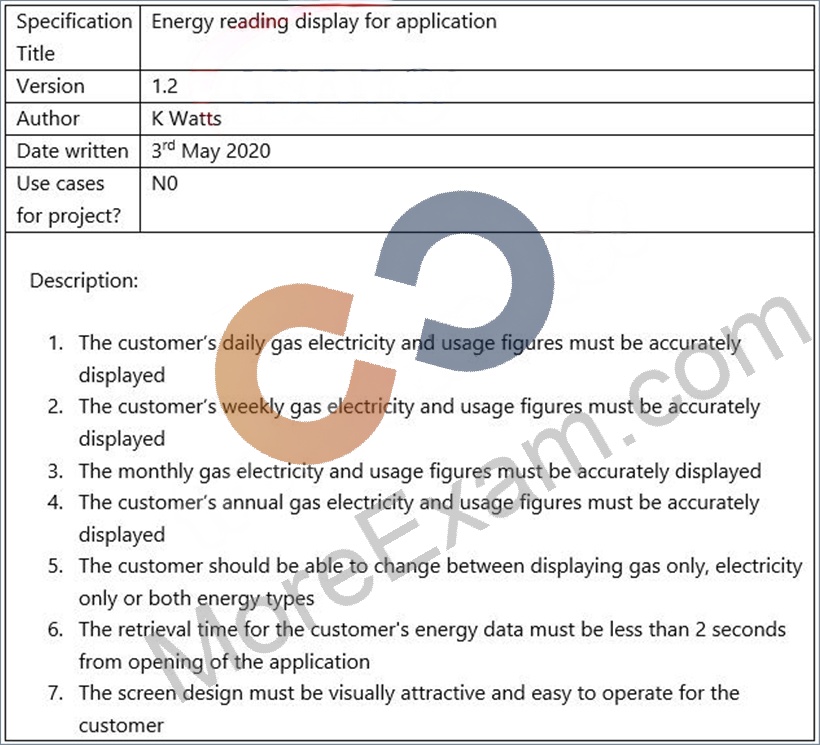
The company is to launch a new application for smartphones and tablets that will allow its customers to view their energy readings remotely and to view their daily budget usage based on seasonal historic data. The application must also support customers with disabilities.
The following requirement specification has been written and you are reviewing it:

You are using the following review checklist
Is each requirement testable?
Does each requirement have acceptance criteria listed?
Is a use case calling structure available (if applicable)?
Are the requirements uniquely identified?
Is the specification versioned?
Is there traceability visible from each requirement to the business/marketing requirements?
Is there traceability between the requirements and the use cases (if applicable)?
Based on this checklist, which items are NOT met and will fail review?

Question49: A route calculation for a car navigation system has been developed using the following state table:

How many test cases are needed to achieve 0-switch coverage?

Question50: Using the "Tax System" specification scenario as described above, using boundary value analysis, which would be the most interesting test set to explicitly test one single boundary value as defined in the "Tax System" specification?

Question51: Which task is NOT considered the responsibility of the Test Analyst as part of the test Implementation activities?